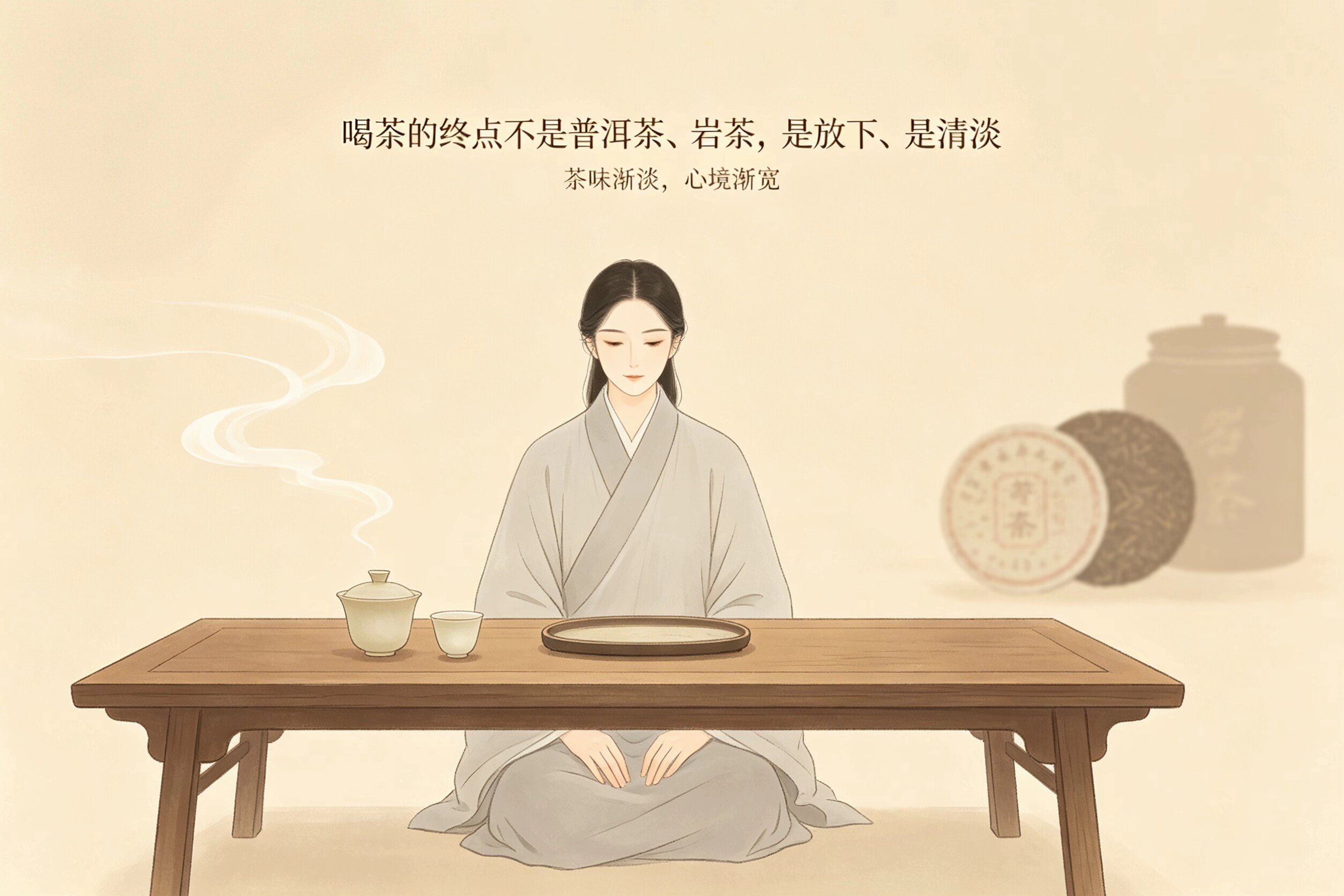
The end of tea drinking isn't Pu'er or Yancha—it's letting go, embracing simplicity.
In recent years, a curious trend has emerged in the tea community: those who claim to "know tea" often take sides between Pu'er and Yancha. The former emphasizes aging potential, with frequent references to mountain origins, ancient trees, and pure varieties; the latter highlights its distinctive mineral backbone and floral aroma, debating distinctions like "true rock," "semi-rock," and specific valley locations in increasingly esoteric terms. It seems that without experiencing both, one is considered disconnected from the essence of tea culture.
In recent years, a curious trend has emerged in the tea community: those who claim to "know tea" often take sides between Pu'er and Yancha. The former emphasizes aging potential, with frequent references to mountain origins, ancient trees, and pure varieties; the latter highlights its distinctive mineral backbone and floral aroma, debating distinctions like "true rock," "semi-rock," and specific valley locations in increasingly esoteric terms. It seems that without experiencing both, one is considered disconnected from the essence of tea culture.
But upon reflection, is this an evolution of tea appreciation, or just another form of obsession?
The essence of tea ceremony lies not in the tea itself, but in the heart.
Lu Yu's "The Classic of Tea" opens with: "Tea is cold in nature and best suited for those who practice moderation and cultivate virtue." The text never mentions which tea is most expensive or which mountain produces the rarest leaves; instead, it focuses on harvesting, processing, brewing, and drinking—emphasizing a simple, steady mindset. Xu Cishu's Ming Dynasty essay "On Tea" states even more clearly: "Tea should be drunk regularly but not excessively; lightly brewed, never too strong." Regularity and lightness are the true essence of tea.
Today, discussions on tea often invoke mystical terms like "tea energy," "throat resonance," and "physical sensation." Yet, if you browse through historical tea texts, you will never find them ranking tea into tiers or judging quality by price. The true spirit of Chinese tea culture lies in Su Shi's carefree "Let us finish Lu Tong's seven bowls of tea" and Bai Juyi's leisurely "Sitting, pouring cool water, watching the fine dust settle while brewing." As for the concept that "tea and Zen are one," where does this unity lie? It is not in the strength, lightness, or cost of the brew, but in the act of lifting the cup and setting it down.
II. Pu'er and Yancha: The Mythologized "Final Destination"
Pu-erh tea was elevated to legendary status only in the past two decades. Capital inflows, scarcity of ancient trees, and its financial attributes have overshadowed its role as a beverage. A single cake now commands tens of thousands of yuan; people aren't drinking tea—they're consuming exclusivity and social status. The same holds true for rock tea: names like "Beef" and "Horse Meat" are sold at astronomical prices. What's being consumed isn't rock rhyme—it's social currency.
This mindset assumes that drinking expensive, rare teas means you've "truly understood" them. Yet this pursuit goes against the Dao itself. As Laozi said, "Five colors blind the eye, five tones deafen the ear." Overindulging in sensory stimulation dulls the palate instead. Once your tongue grows accustomed to bold, intense brews, it can no longer detect the subtle nuances in lighter infusions—that's not progress; it's regression.
Worse still, tea tasting has turned into an exam: shame if you can't identify the mountain origin, embarrassment if you can't name the vintage. Tea should be relaxing, yet it's become a new source of anxiety. This isn't about enjoying tea—it's about getting caught up in the game.
III. True Flavor Emerges Only When You Let Go
"Letting go"has two meanings. First, let go of the obsession with "fine tea." Don't judge tea by price or fame; return to its essence as a beverage. It quenches thirst when you're thirsty and calms your mind when you're relaxing—that's all it is. Second, let go of the self that seeks to be an "expert." You don't need to prove who you are by what tea you drink, and tea doesn't need your admiration to show its value.
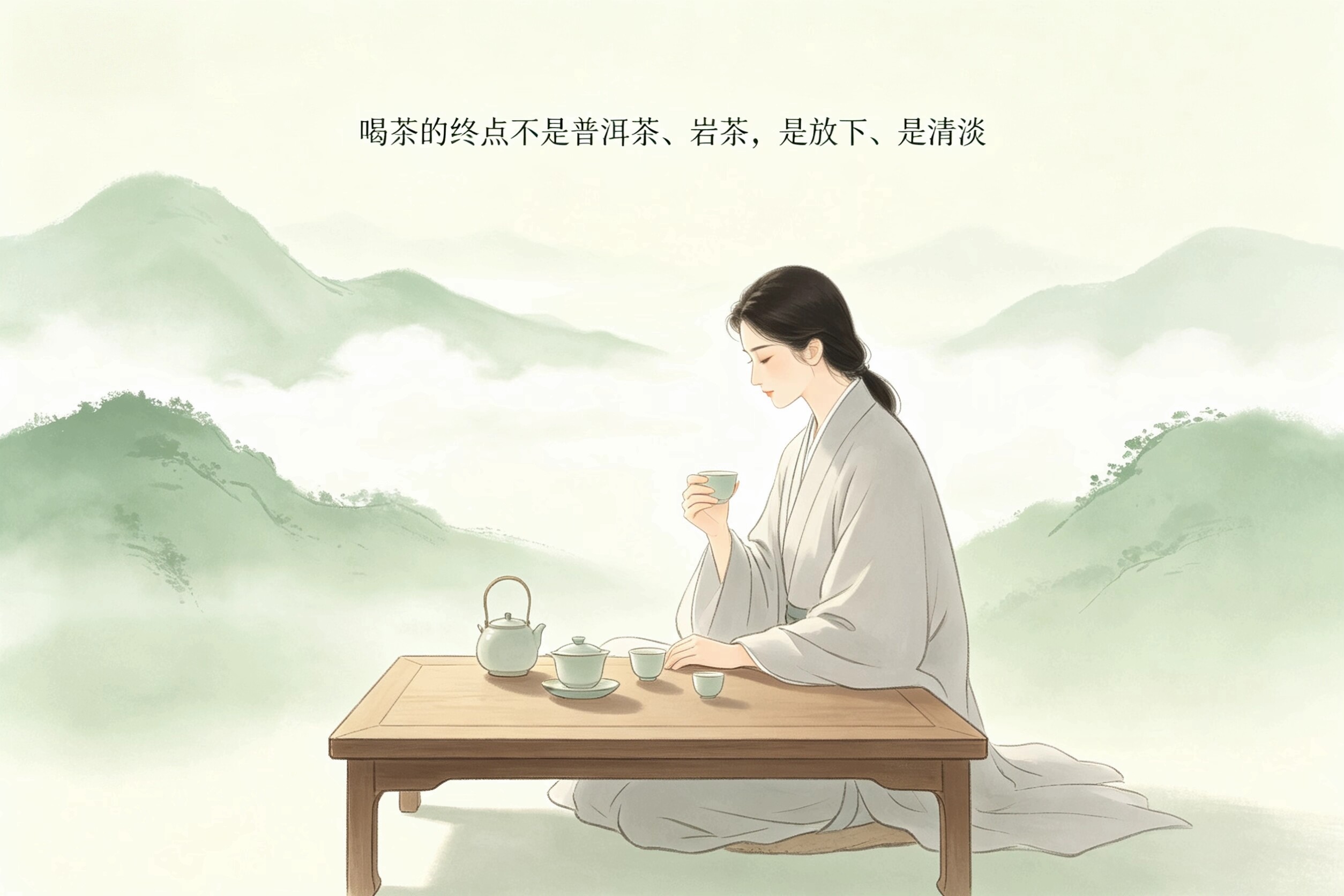
The famous Zen koan from the Tang Dynasty, where Master Zhaozhou simply said "Drink tea" in response to a question about the essence of Buddhism, illustrates a profound truth: enlightenment is not somewhere else, but right here in this very cup. When you lift the cup and drink, that act itself is everything. But if, while drinking, you're thinking about where the tea was grown or worrying whether others will think you don't understand, then you haven't truly drunk it at all.
Japanese tea ceremony embraces the concept of "ichigo ichie"—each encounter is unique and will never be repeated. The same applies to a cup of tea: whether it's Pu'er, jasmine, rock oolong, or broken leaves, treat this cup as it is. Drink it, let it go, and move on without lingering thoughts.
IV. "Lightness" is a return to taste and a return of the mind.
Lightness is easy to say but hard to achieve. It means your palate hasn't been conditioned by strong flavors, and your heart isn't filled with desire. Only those who can enjoy a light tea will taste its subtle sweetness—the true flavor of the tea itself, unenhanced by processing or age, simple and authentic.
In his later years, Master Hong Yi lived with minimal dietary habits—a side dish of pickles and a bowl of plain rice porridge. He once said, "Salty has its own flavor; bland has its own." The same applies to tea. That faint hint of sweetness in lightly brewed tea is harder to grasp than the intense punch of strong tea, yet it draws closer to the essence of the Way. It doesn't flatter you or stimulate you; it simply waits there for you to settle down before whispering its secret.
As the ancients said, "The greatest flavor is the blandest." True depth lies in simplicity. Intense flavors can be addictive and lead to confusion. A light tea won't excite you, but it stays with you for a long time—like a silent old friend: quiet, yet deeply comforting.
5. Only by returning to the start can you find your way to the finish.
Many people start with jasmine or green tea, gradually drinking stronger and more expensive blends, believing they're moving up. That's not true. True tea connoisseurs eventually return to simplicity—a refined cup of Tongshun Tai white tea, or even just clean water.
This isn't a step back; it's the result of a long journey that helped me realize what I truly need. Like someone who spent years away, only to return home and discover that nothing beats the simple bowl of noodles from childhood.
After experiencing the depth of Pu'er and the sharp aroma of Yancha, returning to a cup of light tea with quiet appreciation—no longer comparing or judging—is when you truly know how to drink tea.
When the tea cools, refill it. If it gets weak, drink it as is. Many things in life are just like that.